Kathavarnan story
Kaliya and the Yamuna
कालिय और यमुना
A reader-friendly guide to the Kaliya story: Krishna, the poisoned Yamuna, the fear in Vraja, Kaliya’s defeat, mercy, and the Hindi audio telling on Kathavarnan.
Story overview
A reader-friendly guide to the Kaliya story: Krishna, the poisoned Yamuna, the fear in Vraja, Kaliya’s defeat, mercy, and the Hindi audio telling on Kathavarnan.
यमुना के विषैले कुंड से कालिय को हटाने, व्रज को सुरक्षित करने और विजय के बाद दया की सीमा तय करने की कथा।
Source context
Retold from Vishnu Purana, Book V, Chapter VII.
Story brief
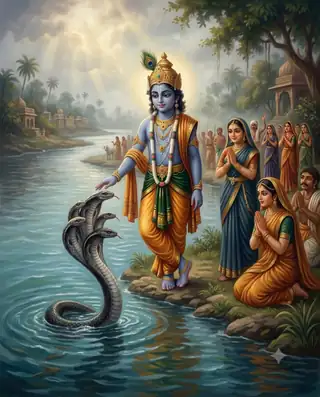
The Kaliya episode begins with a practical danger, not simply a battle. A pool of the Yamuna near Vraja has become poisonous because the serpent king Kaliya lives there, making the water and surrounding area unsafe for people, cattle and wildlife. Krishna decides the danger cannot remain. What follows is remembered for Krishna dancing on Kaliya’s hoods, but the story’s ending matters just as much: Kaliya is subdued, spared and ordered to leave the river.
Krishna reaches the Yamuna with cowherd companions while Balarama is elsewhere. They come to a pool whose danger is visible in the damaged vegetation and harm caused to birds by the poisoned water and vapour. In the Vishnu Purana-led telling used by Kathavarnan, Krishna recognizes that Kaliya’s presence has turned part of a shared river into a place the community cannot safely use. He climbs a kadamba tree, prepares himself and jumps into the water to confront the source of the danger.
The disturbance draws Kaliya out. The serpent coils around Krishna and attacks him while the cowherd boys watch in alarm. Some run back to Vraja with the news. Nanda, Yashoda, Balarama and the wider cowherd community hurry to the river, where they see Krishna apparently trapped. Their reaction gives the scene its emotional weight: they do not experience it first as a demonstration of divine power, but as a threat to someone they love. Balarama, however, is portrayed as understanding Krishna’s strength.
Krishna then frees himself and turns the struggle. As Kaliya raises his heads, Krishna forces them down and dances on the serpent until his resistance is broken. Kathavarnan avoids treating the scene as spectacle alone or fixing a precise number of hoods, because those details vary across retellings. The important movement in the selected source is clear: Kaliya can no longer keep control of the poisoned pool or continue threatening those who depend on the Yamuna.
At that point the story changes direction. Kaliya’s wives approach Krishna and ask that his life be spared, and Kaliya also submits. Krishna does not kill him, but neither does he allow him to remain. Kaliya is commanded to leave the Yamuna with his family and followers and go to the ocean. The Vishnu Purana also connects Krishna’s footprints on Kaliya’s head with protection from Garuda, the enemy Kaliya fears. Mercy therefore comes with a firm boundary: the serpent lives, but the river must be released.
Kaliya departs, and the Yamuna becomes safe again. The cowherd community can return to the river without the old fear, and Krishna returns with them to Vraja. This ending completes the arc that begins with a poisoned shared resource: the danger is removed, the community regains access, and the defeated opponent is not pursued after he accepts the condition that restores safety. The famous image of Krishna above Kaliya’s hoods is only one moment inside that larger story.
Context
Kathavarnan places this episode in Krishna’s Vraja/Vrindavan childhood, when daily life is closely tied to cattle, grazing land and the Yamuna. This page follows the project’s approved Kaliya source brief, led by Vishnu Purana, Book V, Chapter VII. Bhagavata Purana material is used only to understand variant traditions unless a detail is separately approved for this edition; the brief therefore does not silently import the Bhagavata’s fuller Garuda backstory, celestial details or differing hood descriptions.
Key moments
- Krishna reaches a Yamuna pool made dangerous by Kaliya’s poison.
- Krishna enters the water and Kaliya coils around him.
- The frightened cowherd community gathers at the river.
- Krishna frees himself and subdues Kaliya.
- Kaliya’s wives ask for mercy.
- Krishna orders Kaliya to leave the Yamuna with his family.
- The river becomes safe again and Krishna returns to Vraja.
Characters in this story
- Krishna — The central figure who confronts Kaliya to remove the danger from the Yamuna and Vraja.
- Kaliya — The serpent king occupying and poisoning the Yamuna pool, later subdued and ordered to leave.
- Yashoda — Krishna’s mother in the Vraja household, whose fear gives the river scene its emotional stakes.
- Nanda — Leader of the cowherd community and Krishna’s father in the household, who comes to the river after the alarm.
- Balarama — Krishna’s elder brother, present with the community and portrayed as understanding Krishna’s power.
- Kaliya’s wives — They plead for Kaliya’s life after he is weakened, creating the story’s turn from punishment to mercy.
Why this story matters
Kathavarnan’s editorial reflection is that the climax is not only Krishna’s victory over Kaliya. The more distinctive turn comes after the danger has been controlled. Krishna stops the harm, accepts the plea for mercy, and still requires Kaliya to leave the place he made unsafe. That creates a useful distinction between mercy and permission: sparing an opponent does not mean restoring the conditions that allowed the harm. This is a present-day reading of the narrative, not a quotation or doctrinal claim from the Vishnu Purana.
संक्षेप में
कालिय की कथा सिर्फ़ कृष्ण और नाग के युद्ध की कहानी नहीं है। यमुना को सुरक्षित करने के बाद कृष्ण कालिय को मारते नहीं, बल्कि उसे परिवार सहित नदी छोड़कर समुद्र जाने का आदेश देते हैं—यहीं कथा शक्ति, सीमा और दया को साथ रखती है।
Common questions
Why did Krishna fight Kaliya?
Kaliya’s poison had made a pool of the Yamuna dangerous to people, cattle, vegetation and wildlife. In the selected Vishnu Purana-led telling, Krishna confronts Kaliya in order to remove that danger and make the area usable by the Vraja community again.
Did Krishna kill Kaliya?
No. Krishna subdues Kaliya, accepts the pleas for mercy, and orders him to leave the Yamuna with his family and followers. The story ends with Kaliya alive and the river safe again.
Where did Kaliya go after leaving the Yamuna?
In the Vishnu Purana witness used for this Kathavarnan edition, Krishna orders Kaliya to leave with his household and go to the ocean. Krishna’s footprints on Kaliya’s head are also presented as protection from Garuda.
Listening guide
Set aside about 12 min for this single-part Hindi narration by Tara.
Chapters
- कालिय और यमुना
Themes in this story
- Krishna
- Kaliya
- Yamuna
- Vrindavan
Explore this topic
Research approach
Continue exploring
- Under Govardhan Hill — गोवर्धन, इंद्र के क्रोध और पूरे समुदाय को आश्रय देने वाली शक्ति की कथा।
- Yashoda's Rope and the Twin Trees — यशोदा, बालक कृष्ण और उस बंधन की कथा जो प्रेम, धैर्य और मुक्ति की ओर खुलता है।
- Akrura's Journey to Vrindavan — कर्तव्य, भक्ति और कृष्ण को वृंदावन से मथुरा ले जाने की कठिन जिम्मेदारी के बीच अक्रूर की यात्रा।