Kathavarnan story
Yashoda's Rope and the Twin Trees
यशोदा की रस्सी और जुड़वाँ वृक्ष
A reader-friendly guide to the Damodara story: Yashoda binds young Krishna to a mortar, two Arjuna trees fall, and Vraja prepares to move.
Story overview
A reader-friendly guide to the Damodara story: Yashoda binds young Krishna to a mortar, two Arjuna trees fall, and Vraja prepares to move.
यशोदा, बालक कृष्ण और उस बंधन की कथा जो प्रेम, धैर्य और मुक्ति की ओर खुलता है।
Story brief
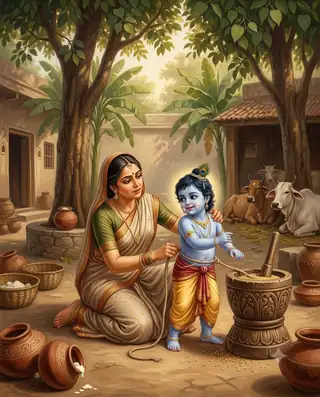
The Damodara episode begins as a household problem. Young Krishna is difficult for Yashoda to keep in one place, and her attempt to set a boundary leads to an extraordinary event: Krishna is tied by the waist to a heavy wooden mortar, drags it between two closely growing Arjuna trees, and the trees fall. In Kathavarnan’s Vishnu Purana-led production telling, the consequences extend beyond the courtyard—the elders of Vraja eventually decide the community should move to Vrindavana.
Krishna and Balarama are still very young in this episode, moving through the busy domestic world of Vraja. The source presents Yashoda as struggling to stop Krishna from roaming where he should not. She follows him in anger with a stick, catches him, and decides to restrain him. Kathavarnan keeps that source detail without turning it into parenting advice: the scene is narrated as a moment of exasperation, worry and attempted control rather than as an example to imitate.
Yashoda ties a cord around Krishna’s waist and fastens the other end to a heavy wooden mortar. The obvious expectation is that the weight will keep the child nearby. Krishna begins moving anyway, pulling the mortar behind him until he reaches two large Arjuna trees growing close together. He can pass through the gap, but the mortar cannot. It catches between the trunks as the rope tightens.
Krishna continues to pull. The two trees fall, and the sound brings the cowherds running. They find a striking contrast: enormous fallen trees, the heavy mortar between them, and the small child still bound by the cord. The selected Vishnu Purana witness does not include the Bhagavata tradition’s Nalakuvara and Manigriva backstory for the trees, so Kathavarnan does not silently add those figures to this edition.
The episode connects Krishna’s binding with the name Damodara—the child marked in memory by the cord around his belly or waist. But the fallen trees also deepen the adults’ concern. The elders have already witnessed a series of extraordinary and alarming events around the children. Instead of treating the latest incident as something to ignore, they begin considering whether remaining in the same place is wise.
The cowherd elders decide to move the community to Vrindavana, a place regarded as suitable for their cattle and way of life. Families, carts and animals move together, and the narrative closes by opening the next stage of Krishna and Balarama’s childhood among the pastures and forests. In this source boundary, the Damodara episode therefore links a very intimate mother-and-child scene to a larger community decision about safety and where to live.
Context
Kathavarnan’s adult web production follows H. H. Wilson’s 1840 English witness of Vishnu Purana, Book V, Chapter VI. This selected source includes Yashoda tying Krishna to the wooden mortar, the fall of the two Arjuna trees, the Damodara naming connection, and the elders’ decision to move to Vrindavana. It does not include the Bhagavata-specific Nalakuvara and Manigriva explanation for the trees, so that backstory is deliberately outside this edition.
Key moments
- Young Krishna repeatedly wanders beyond the limits Yashoda tries to set.
- Yashoda catches Krishna and ties him by the waist to a heavy wooden mortar.
- Krishna drags the mortar toward two closely growing Arjuna trees.
- The mortar lodges between the trunks and the two trees fall as Krishna pulls.
- The cowherds arrive and find Krishna still bound among the fallen trees.
- The cord around Krishna becomes associated with the name Damodara.
- The elders connect this event with other alarming incidents around the children.
- The cowherd community decides to move to Vrindavana.
Characters in this story
- Krishna — The young child whose movement while bound to the mortar causes the two Arjuna trees to fall.
- Yashoda — Krishna’s mother in the household, whose effort to restrain her roaming child begins the central incident.
- Balarama — Krishna’s young elder brother, part of the family and childhood setting that continues into the move to Vrindavana.
- Nanda and the cowherd elders — The adults who interpret the repeated extraordinary incidents as a safety concern and decide the community should relocate.
- The cowherd community — The families and cattle-owning settlement whose collective move to Vrindavana becomes the episode’s larger consequence.
Why this story matters
Kathavarnan’s editorial reflection holds two scales together. At the household scale, Yashoda is trying to control a situation involving a child she loves and worries about. At the community scale, the elders respond to repeated danger by changing their surroundings rather than simply accepting the risk. The story can therefore be read as a contrast between the limits of control and the responsibility to protect. This is a present-day interpretation, not a quotation or parenting instruction from the Vishnu Purana.
संक्षेप में
दामोदर की कथा में यशोदा चंचल बालक कृष्ण को भारी लकड़ी की ओखली से बाँध देती हैं। कृष्ण उसी ओखली को खींचते हुए दो अर्जुन वृक्षों के बीच जाते हैं, वृक्ष गिरते हैं, और लगातार हो रही असाधारण घटनाओं से चिंतित व्रज के बुज़ुर्ग वृंदावन जाने का निर्णय लेते हैं।
Common questions
Why is Krishna called Damodara in this story?
In the selected Vishnu Purana-led telling, the name is connected with the cord tied around Krishna’s belly or waist when Yashoda fastens him to the wooden mortar.
Why did Yashoda tie Krishna to a mortar?
Yashoda is struggling to keep the very young Krishna from roaming where he should not. She ties him to a heavy wooden mortar because she expects its weight to keep him in one place. Kathavarnan does not present this as modern parenting advice.
Who were inside the two trees in this Kathavarnan version?
This edition does not identify beings inside the trees. The selected Vishnu Purana witness used for production does not contain the Bhagavata tradition’s Nalakuvara and Manigriva backstory, so that detail is not imported.
Why did the people of Vraja move to Vrindavana?
After the tree incident and other extraordinary events around the children, the elders become concerned about safety and decide that moving the community to Vrindavana is the better course.
Listening guide
Set aside about 10 min for this single-part Hindi narration by Tara.
Chapters
- यशोदा की रस्सी और जुड़वाँ वृक्ष
Themes in this story
- Krishna
- Yashoda
- Damodara
- Vrindavan
Explore this topic
Research approach
Continue exploring
- Kaliya and the Yamuna — यमुना के विषैले कुंड से कालिय को हटाने, व्रज को सुरक्षित करने और विजय के बाद दया की सीमा तय करने की कथा।
- Under Govardhan Hill — गोवर्धन, इंद्र के क्रोध और पूरे समुदाय को आश्रय देने वाली शक्ति की कथा।
- Akrura's Journey to Vrindavan — कर्तव्य, भक्ति और कृष्ण को वृंदावन से मथुरा ले जाने की कठिन जिम्मेदारी के बीच अक्रूर की यात्रा।