Kathavarnan story
Akrura's Journey to Vrindavan
अक्रूर की वृंदावन यात्रा
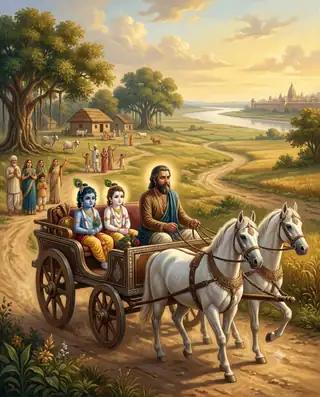
A reader-friendly guide to Akrura’s story: Kansa’s order, Akrura’s divided duty, Krishna and Balarama leaving Vraja, and the Yamuna vision.
Story overview
A reader-friendly guide to Akrura’s story: Kansa’s order, Akrura’s divided duty, Krishna and Balarama leaving Vraja, and the Yamuna vision.
कर्तव्य, भक्ति और कृष्ण को वृंदावन से मथुरा ले जाने की कठिन जिम्मेदारी के बीच अक्रूर की यात्रा।
Story brief
Akrura enters Krishna’s story with a difficult assignment: Kansa orders him to bring Krishna and Balarama from Vraja to Mathura. In Kathavarnan’s Vishnu Purana-led production telling, Akrura is neither reduced to a villain who takes Krishna away nor treated as a neutral messenger with no inner conflict. He serves a dangerous ruler while personally revering Krishna, and the journey forces those obligations into the same chariot.
Kansa decides that Krishna and Balarama should be summoned from Vraja to Mathura and chooses Akrura for the task. Akrura belongs to the Yadava world around Mathura and understands the danger surrounding the king’s plans. At the same time, he has long wanted to see Krishna. The selected Vishnu Purana chapters therefore give his outward journey two meanings at once: it is an order from Kansa, and it is an encounter Akrura approaches with devotion.
When Akrura reaches Nanda’s settlement, he meets Krishna and Balarama, identifies himself and is welcomed rather than treated simply as an enemy envoy. After the initial hospitality, he explains what has been happening in Mathura and why he has come. He speaks about the suffering around Vasudeva and Devaki, Kansa’s treatment of Ugrasena, and the summons to Mathura. Krishna and Balarama decide to travel the next day, while Nanda and other cowherds prepare to accompany the journey with offerings.
The departure carries grief for the people who have lived with Krishna in Vraja. The Vishnu Purana describes the sorrow of the gopis as the brothers leave. Kathavarnan keeps that emotional consequence without inventing private conversations between Akrura and the women of Vraja. The important tension is visible without added dialogue: Akrura is fulfilling the mission he was given, but he can also see that the same mission creates separation for the community he has just entered.
During the journey the party stops at the Yamuna. Akrura goes into the water for ritual bathing and meditation, and the Purana’s sacred narrative opens into a divine vision. He sees Balarama in an immense Shesha form and Krishna in a cosmic or divine form, offers praise, and returns from the water visibly astonished. Krishna notices the change in him and asks whether he has seen something extraordinary. The episode presents this as theological experience inside the Purana’s devotional world, not as modern empirical evidence.
The journey then continues toward Mathura. Near the city, Akrura and the two brothers separate: Krishna and Balarama proceed toward the city on foot while Akrura returns to his own obligations. His assignment is complete, but the larger confrontation with Kansa is only beginning. That makes Akrura’s episode a transition story—between Vraja and Mathura, devotion and duty, and the sheltered childhood world behind Krishna and the political danger ahead.
Context
Kathavarnan’s adult web production follows H. H. Wilson’s 1840 English witness of Vishnu Purana, Book V, Chapters XVII–XIX. The production boundary includes Kansa’s order, Akrura’s journey to Vraja, his meeting and message to Krishna and Balarama, the grief around departure, Akrura’s Yamuna vision, and the separation near Mathura. It deliberately avoids turning Akrura into either a villainous kidnapper or an uncomplicated messenger, and it does not invent modern political motives or private gopi dialogue.
Key moments
- Kansa orders Akrura to bring Krishna and Balarama from Vraja to Mathura.
- Akrura travels toward Vraja while reflecting on the people he has been ordered to summon.
- Krishna and Balarama welcome Akrura and hear the situation in Mathura.
- The brothers decide to travel the next day and the cowherd community prepares for departure.
- The departure from Vraja brings visible grief, especially among the gopis.
- Akrura stops at the Yamuna for ritual bathing and meditation.
- He experiences a divine vision involving Krishna and Balarama.
- Near Mathura, Akrura separates from the brothers as they continue toward the city.
Characters in this story
- Akrura — The Yadava messenger sent by Kansa whose devotion to Krishna creates the episode’s tension between assignment and personal allegiance.
- Krishna — The central figure summoned to Mathura who hears Akrura’s message, agrees to travel, and questions Akrura after the Yamuna vision.
- Balarama — Krishna’s elder brother who receives Akrura with him, travels from Vraja, and appears in Akrura’s sacred vision.
- Kansa — The ruler whose order sends Akrura to Vraja and whose dangerous plans make the journey more than an ordinary invitation.
- Nanda and the cowherd community — Krishna’s Vraja household and community, who receive Akrura and experience the emotional consequences of the brothers’ departure.
Why this story matters
Kathavarnan’s editorial reflection focuses on divided duty. Akrura operates inside a system controlled by Kansa, yet the production telling shows him communicating the real situation rather than disguising it, revering Krishna, and completing his responsibility without pretending the mission has no human cost. That does not turn every act of obedience into virtue; it highlights the narrower question of how much honesty and respect a person can preserve when their role is constrained by someone else’s power. This is a present-day interpretation, not a doctrine quoted from the Vishnu Purana.
संक्षेप में
अक्रूर को कंस कृष्ण और बलराम को व्रज से मथुरा लाने भेजता है। लेकिन अक्रूर स्वयं कृष्ण के भक्त हैं। उनकी यात्रा आदेश और श्रद्धा के बीच चलती है—व्रज का वियोग, यमुना में दिव्य दर्शन और मथुरा के पास दोनों भाइयों से अलग होने तक।
Common questions
Why did Akrura take Krishna to Mathura?
Kansa ordered Akrura to bring Krishna and Balarama from Vraja to Mathura. In the selected Vishnu Purana-led telling, Akrura delivers the message and explains the situation; Krishna and Balarama then decide to make the journey.
Was Akrura against Krishna?
Kathavarnan’s selected source does not treat Akrura as Krishna’s enemy. He serves under Kansa and carries out the king’s order, but he personally reveres Krishna and approaches the meeting with devotion.
What did Akrura see in the Yamuna?
During ritual bathing and meditation, the Vishnu Purana describes Akrura seeing Balarama in an immense Shesha form and Krishna in a divine or cosmic form. Kathavarnan presents this as part of the Purana’s sacred narrative.
Did Akrura enter Mathura with Krishna and Balarama?
In the production source boundary, the joint journey ends near Mathura. Krishna and Balarama continue toward the city while Akrura separates from them and returns to his own obligations.
Listening guide
Set aside about 10 min for this single-part Hindi narration by Tara.
Chapters
- अक्रूर की वृंदावन यात्रा
Themes in this story
- Krishna
- Akrura
- Vrindavan
- Mathura
Explore this topic
Research approach
Continue exploring
- The Fear Before the Birth — Before Krishna is born, one prophecy begins changing Kansa, Devaki, Vasudeva and the future of Mathura.
- Before the Eighth Child — Before the child everyone remembers, Devaki and Vasudeva endure repeated loss while a quiet transfer changes the story between Mathura and Gokul.
- The Night Krishna Was Born — A prison opens, a storm waits outside, and Vasudeva must carry a newborn across the Yamuna — then return.