Kathavarnan story
When Bhima Met Hanuman
भीम और हनुमान की भेंट
A reader-friendly guide to Bhima meeting Hanuman: the Saugandhika flower, the immovable tail, their brotherhood, and a lesson about the limits of strength.
Story overview
A reader-friendly guide to Bhima meeting Hanuman: the Saugandhika flower, the immovable tail, their brotherhood, and a lesson about the limits of strength.
सुगंधिका पुष्प की खोज में निकले भीम की ऐसी भेंट, जहाँ अपार शक्ति को विनम्रता और बड़े भाई की पहचान से नया अर्थ मिलता है।
Source context
Retold from the Mahabharata, Vana Parva, sections CXLV–CLI in the Ganguli translation.
Story brief
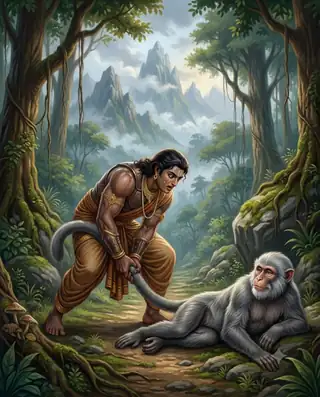
Bhima and Hanuman’s meeting is remembered for one compact image: the immensely strong Bhima cannot move the tail of an old monkey lying across his path. In Kathavarnan’s Mahabharata-led production telling, that scene is not just a joke at Bhima’s expense. It begins with Draupadi asking for more Saugandhika flowers and becomes a meeting between brothers through the wind-god—one that changes how Bhima measures strength.
During the Pandavas’ forest exile, a fragrant Saugandhika lotus reaches Draupadi on the wind. She asks Bhima to obtain more of the flowers. The selected Mahabharata source does not frame the request as frivolous or blameworthy, and Kathavarnan follows that boundary. Bhima sets out through the mountain forest with confidence in the strength that has carried him through many dangers before.
On a narrow path he finds what appears to be an aged monkey lying across the way, its tail blocking passage. Bhima asks the animal to move. The monkey says he is old and cannot easily rise, and instead invites Bhima to move the tail himself. The task looks trivial to Bhima, especially compared with the feats he knows he can perform.
Bhima first tries casually, then with both hands and full strength. The tail does not move. No weapon defeats him and no opponent strikes him; his confidence is challenged by something he initially considers too small to matter. That failure changes the conversation. Bhima stops issuing commands and asks who the monkey really is.
The monkey reveals himself as Hanuman, another son of the wind-god and therefore Bhima’s elder brother. Their meeting links the Mahabharata episode to Hanuman’s older Ramayana story. Bhima asks about Hanuman’s past deeds and requests to see the enormous form associated with the leap across the ocean. Hanuman eventually reveals a vast form that overwhelms Bhima’s ability to take it in, then returns to a gentler size.
The encounter ends with counsel, kinship and blessing rather than humiliation or combat. Bhima’s physical strength has not disappeared; he remains one of the Mahabharata’s great warriors. What changes is his sense of scale. The episode leaves him with a recognition that his own power is real without being the final measure of all power, and that meeting someone greater does not erase his own capacity.
Context
Kathavarnan’s adult web production follows K. M. Ganguli’s public-domain Mahabharata, Book 3, Vana Parva, sections CXLV–CXLIX. The fixed production boundary includes the Saugandhika flower, Bhima’s journey, Hanuman appearing as an aged monkey, the immovable tail, their shared paternity through the wind-god, discussion of Hanuman’s Ramayana deeds, the immense form, and the brothers’ parting with counsel and blessing. The encounter is not framed as a physical fight.
Key moments
- A Saugandhika lotus reaches Draupadi on the wind.
- Draupadi asks Bhima to obtain more of the flowers.
- Bhima sets out through the mountain forest confident in his strength.
- An aged monkey lies across the narrow path and asks Bhima to move its tail.
- Bhima cannot move the tail even with full strength.
- The monkey reveals himself as Hanuman, Bhima’s elder brother through the wind-god.
- Bhima asks to see Hanuman’s immense Ramayana-era form.
- The meeting ends with counsel and blessing rather than combat.
Characters in this story
- Bhima — The powerful Pandava whose confidence in his own strength is challenged and broadened by the encounter.
- Hanuman — Bhima’s elder brother through the wind-god, appearing first as an aged monkey and later revealing his true identity and immense form.
- Draupadi — The Pandava queen whose request for more Saugandhika flowers sets Bhima’s journey in motion.
- Vayu / the wind-god — The divine parent through whom the episode establishes Bhima and Hanuman as brothers.
Why this story matters
Kathavarnan’s editorial reflection is that humility does not require pretending to be weak. Bhima’s strength remains genuine after the encounter; what changes is his assumption that his own strength is the relevant scale for everything he meets. Hanuman’s lesson is therefore less about breaking Bhima and more about enlarging his frame of reference. This is a present-day interpretation of the episode, not a universal moral rule quoted from the Mahabharata.
संक्षेप में
भीम सौगंधिक फूल लाने निकलते हैं और रास्ते में एक वृद्ध वानर की पूँछ तक नहीं हिला पाते। वही वानर हनुमान निकलते हैं—पवनदेव के कारण भीम के बड़े भाई। मुलाकात भीम की शक्ति छीनती नहीं, बल्कि उसे यह समझ देती है कि उसकी शक्ति अंतिम पैमाना नहीं है।
Common questions
Why could Bhima not move Hanuman’s tail?
The Mahabharata episode presents the apparently ordinary monkey as Hanuman in disguise. Bhima’s inability to move the tail reveals that the being before him is far beyond the scale he first assumed.
Are Bhima and Hanuman brothers?
In the selected Mahabharata tradition, both are sons of the wind-god, which is why Hanuman identifies himself as Bhima’s elder brother.
Why was Bhima looking for the Saugandhika flower?
A fragrant Saugandhika lotus reached Draupadi during the forest exile, and she asked Bhima to obtain more of the flowers. His journey to find them leads to Hanuman.
Did Bhima fight Hanuman?
No. The central challenge is the immovable tail, followed by recognition, conversation and blessing. The production source boundary treats the encounter as instruction between brothers, not a duel.
Listening guide
Set aside about 10 min for this single-part Hindi narration by Tara.
Chapters
- भीम और हनुमान की भेंट
Themes in this story
- Mahabharata
- Bhima
- Hanuman
- Gandhamadana
Explore this topic
Research approach
Continue exploring
- Astika and the Snake Sacrifice — जनमेजय के सर्पसत्र को रोकने वाले आस्तीक की कथा—प्रतिशोध के बीच संयम और सामूहिक दंड पर प्रश्न।
- Ruru and Dundubha — शोक से उपजे क्रोध के बीच रुरु की मुलाकात ऐसे डुण्डुभ से होती है जो उसे दोष और प्रतिशोध के बीच फर्क दिखाता है।
- Jajali and Tuladhara — तपस्वी जाजलि और व्यापारी तुलाधार के संवाद में रोजमर्रा की ईमानदारी, अहिंसा और विनम्रता पर विचार।